
WAIKOLOA, Hawaii — A study found that Qlosi demonstrated positive pupil diameter reductions without yielding significant changes in ciliary muscle response, according to a speaker at Hawaiian Eye 2026.
In a presentation, Florence Cabot, MD, of Bascom Palmer Eye Institute in Miami, shared data that compared the impact of Qlosi (pilocarpine hydrochloride ophthalmic solution 0.4%, Orasis Pharmaceuticals), pilocarpine 2% and balanced salt solution on pupil diameter, ciliary muscle thickness and lens thickness. The study enrolled 10 participants with less than 4 D of myopia, ages 45 to 64 years, each of whom received OCT imaging before and after receiving each treatment. Patients underwent three treatment sessions, where they were treated with balanced salt solution, Qlosi and pilocarpine 2%, respectively.
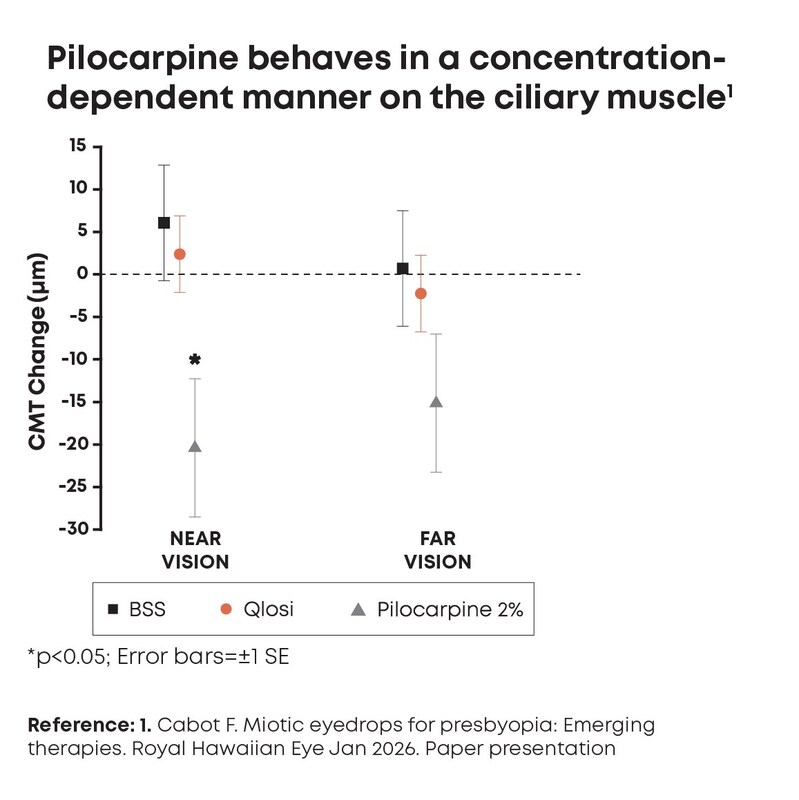
Qlosi yielded significant reductions in pupil diameter (near vision: –0.52 mm, P < .01; far vision: –0.53 mm, P < .01); however, there were no significant changes in ciliary muscle thickness (near vision: 2.4 µm; far vision: –2.3 µm) or lens thickness (near vision: 6.3 µm; far vision: 10.5 µm).
The ciliary muscle movement at near with Qlosi was “indistinguishable” from the balanced salt solution control, Cabot said in a press release from Orasis.
“In terms of pupil diameter, the pilocarpine shows a concentration-dependent effect on the pupil diameter, meaning the pilocarpine 2% has a greater effect on pupil diameter constriction than the pilocarpine 0.4%,” she told Healio.
In her presentation, Cabot emphasized that pilocarpine 2% was the only formulation tested that showed a statistically significant impact on ciliary muscle thickness and a residual lens accommodative effect.
“Further studies are needed, of course, but it looks like the pilocarpine concentration has a different effect on the accommodation and accommodative process,” she told Healio.
Perspective

As a co-moderator for the Hawaii Eye and Retina refractive surgery session, I found this presentation to be important and timely.
There is growing interest and excitement in the management of presbyopia with miotic eye drops. Dr. Cabot has confirmed that the side effects associated with miotic eye drops are dose related with lower concentrations, inducing less brow ache, headache, erythema and ciliary muscle spasm. Patients treated with miotic eye drops should be under the care of an eye doctor with a complete eye examination followed by proper counseling and long-term follow-up. As with any prescription eye drop therapy, the benefits, potential risks, side effects and alternatives should be discussed.
As we learned decades ago when treating glaucoma, a lower-concentration miotic is preferred when initiating treatment.

The development of pharmacologic drops for presbyopia correction is exciting.
I had the opportunity to co-moderate an engaging session at Hawaiian Eye and Retina where Dr. Cabot presented this novel new data showing that 0.4% pilocarpine significantly reduced pupil diameter while demonstrating ciliary muscle movement the same as balanced salt solution control.
In my clinic, we have been offering drops to anyone who desires treatment of presbyopia before proceeding to surgery as well as an adjunct to presbyopia surgery when patients desire an additional effect in certain situations. I was particularly intrigued with the study findings.
Dr. Cabot also said in a press release from Orasis: “These findings are very encouraging, supporting that pilocarpine 0.4% is pupil selective and behaves in a concentration-dependent manner, reinforcing that low-concentration options may be particularly meaningful for patients considering a presbyopia therapy that balances both efficacy and safety.”
These results reinforce my practice’s decision to utilize presbyopia drops while keeping concentration (and safety) in mind when determining what to offer first line.

Sources & Disclosures:
Source:
Cabot F. Miotic eyedrops for presbyopia: Emerging therapies. Presented at: Hawaiian Eye 2026; Jan. 17-23, 2026; Waikoloa, Hawaii.
Reference:
New data demonstrate Qlosi is pupil selective with ciliary muscle movement no different than a balanced salt solution (BSS) control. https://www.orasis-pharma.com/new-data-demonstrate-qlosi-is-pupil-selective-with-ciliary-muscle-movement-no-different-than-a-balanced-salt-solution-bss-control/. Published Jan. 27, 2026. Accessed Feb. 3, 2026.
Disclosures: Cabot reports receiving grant support and grant funding from Orasis Pharmaceuticals.
Full Article: Qlosi shows no significant impact on ciliary muscle